

Before we get into treatments available, let’s take a look at the most common causes of inner knee pain and the key symptoms to look out for.
Causes of inner knee pain
Inner knee pain, also called medial knee pain, is a common symptom that can affect people after an injury or develop gradually over time. People often experience other symptoms too, including pain, stiffness, or tenderness on the inside of the knee and may be worse when walking, bending, squatting, or using stairs. If your inner knee pain has been caused by an acute injury, you may even hear a “pop” sound when the injury happens.
There are many causes of inner knee pain, but some are more likely than others.
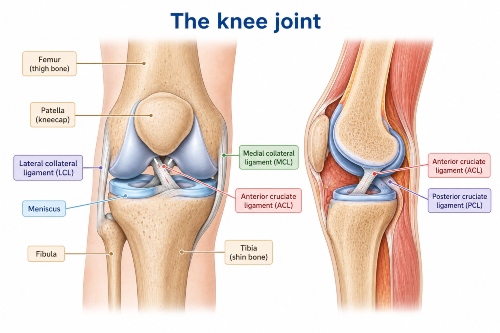
Medial collateral ligament (MCL) injury
The medial collateral ligament (MCL) is the strong band of tissue on the inner side of your knee, connecting your thigh bone (femur) to your shin bone (tibia). Its purpose is to keep your knee stable and stop it bending inwards towards your other leg.
An MCL injury refers to an overstretch, partial tear or complete tear of the ligament and is one of the most common of all knee injuries. Injury to the MCL can happen due to:
A direct impact, such as a blow to the knee that forces it to bend inwards.
Sudden twisting of your knee while your foot remains planted.
Contact sports, like football and rugby, and twisting sports like skiing.
You may notice symptoms like bruising, swelling and joint stiffness in addition to pain.
Anterior cruciate ligament (ACL) injury
Also known as the ACL, the anterior cruciate ligament is the tough band of tissue found in the centre of your knee, also connecting your thigh and shin bones, and preventing your shin bone from sliding forward.
An ACL injury is a sprain or tear of this ligament and most often happens during sports like football or basketball where you need to change directions quickly. In addition to pain, you may hear a popping sound if your ACL is damaged.
Meniscal injury
The meniscus is a c-shaped pad of rubbery cartilage that works as a shock absorber in your knee joint. Each knee has two of them, the medial meniscus on the inner side of your knee, and the lateral meniscus on the outside.
A meniscus tear can be caused by a sudden, acute injury like those seen in ACL and MCL damage, or by gradual cartilage wear over time. In addition to pain, it can cause symptoms like swelling, stiffness and a feeling as though your knee may buckle.
Osteoarthritis of the knee
Osteoarthritis is a degenerative joint disease that can affect any joint within your body, including your knees. It happens when the protective cartilage that usually covers the end of bones within joints to protect them against friction when you move starts to break down, causing the bones to rub together.
Anyone can develop knee osteoarthritis, but you’re more likely to be affected if:
You’re older, as damage occurs with time.
You are overweight or obese as this can put added pressure on the joint.
You’ve had a previous injury to your knee.
You do a job or activity that puts repetitive strain through your knee.
Pain is one of the most common symptoms, along with stiffness, limited range of movement, and crepitus (a popping, clicking or grating noise when moving the joint).
Patellofemoral pain syndrome (PFPS)
Also known as ‘runner’s knee’, patellofemoral pain syndrome (PFPS) is a common condition causing dull, aching pain in or around the knee joint. It’s usually made worse by activities that put additional load on the joint while the knee is bent, such as sitting, squatting or climbing stairs.
Although occasionally the result of an injury, PFPS usually develops gradually from repetitive stress on the knee joint, muscle imbalance or structural abnormalities, which cause the kneecap to track improperly in the groove of the thigh bone. This irritates the surrounding soft tissue and bone, causing pain.
Pes anserinus syndrome
Also known as inner knee bursitis, this occurs when there is inflammation of the fluid-filled sac (bursa) on the inner side of your shinbone, just below your knee joint. It causes pain and swelling, and the area can feel warm to the touch. Repetitive movements will make it worse, and in some cases, infection in the bursa can develop.
Medial plica syndrome
Medial plica syndrome is a knee condition where a normal fold of tissue inside the knee becomes irritated, inflamed or thickened and starts causing pain, usually on the inner front part of the knee. It commonly causes aching pain, clicking, snapping or catching, or pain with squatting, stairs, running or repeated bending and straightening of your knee.
This table helps you compare the above conditions, causes and symptoms side-by-side.
When to seek medical help
You should seek medical help for knee pain if it is severe, is the result of an injury or is getting progressively worse despite any self-treatment you may have tried. This includes rest, ice and anti-inflammatory medications.
You should seek urgent medical advice if:
You can’t bear weight on your knee at all.
There is major swelling.
There is obvious deformity.
You have a fever, feel unwell, or your knee is red or hot to the touch.
This is because you could have significant structural damage to your knee, or you have symptoms that could be indicative of an infection.
Diagnosis of inner knee pain
Your doctor will want to try and identify the cause of your inner knee pain to be able to recommend the best course of treatment.
Diagnosis usually starts with your doctor asking how the pain started, exactly where and when it hurts, and if there’s anything that makes the pain and other symptoms worse. They will ask about your medical history and conduct a physical examination. This will inspect for bruising and swelling, assess your range of movement, check for points of tenderness and test the stability of the joint.
Doctors classify some types of injuries, including MCL injuries, into different grades to determine which treatment to recommend. For example:
Self-help for inner knee pain
There are a number of things you can do, and equally shouldn’t do, to help with inner knee pain yourself, that don’t require the support of a medical professional.
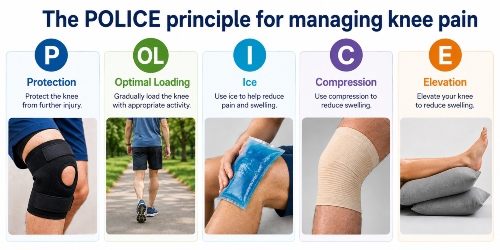
POLICE principle
The POLICE principle is a simple way to manage many acute knee injuries. It stands for:
P: Protection
OL: Optimal Loading
I: Ice
C: Compression
E: Elevation
The theory behind the POLICE principle is to carefully manage the healing and recovery process using tried and tested techniques. This starts with protecting it from further damage in the initial stages of your recovery.
That is followed by gentle movement and gradual weight loading to build strength and mobility. Ice, compression and elevation are all effective at helping to manage pain and swelling as your knee heals.
HARM principle
The HARM principle describes what specifically should be avoided in the first 48 to 72 hours after a knee injury. It is essentially the ‘protection’ part of the POLICE principle listed above. It stands for:
H: Heat
A: Alcohol
R: Running
M: Massage
You should avoid hot baths, showers, saunas, heat packs or similar as this dilates blood vessels and makes swelling significantly worse. Similarly, avoid alcohol and massage, each of which can increase bleeding and swelling. You should also avoid running as doing so, or any other moderate to high-impact exercise, will place strain on the damage, potentially making it worse.
Treatment of inner knee pain
Treatment for inner knee pain depends on the cause, but most people start with conservative care: activity modification and exercise-based physiotherapy (as outlined in the POLICE approach above) in addition to pain medications. If the pain is from a soft-tissue injury or osteoarthritis, this approach is usually the first step before considering injections or surgery.
If symptoms are caused by a specific problem such as osteoarthritis, a ligament sprain, meniscal injury, bursitis or inflammatory arthritis, treatment may be tailored to the underlying diagnosis. Some people may benefit from bracing, crutches or corticosteroid injections, while surgery is usually reserved for more serious or persistent cases.
Inner knee pain and exercise: what’s safe and what to avoid
For most inner knee conditions, the goal is to keep moving without adding twisting, impact or deep bending that flares pain. Low-impact cardio, gentle strengthening and controlled range-of-motion work are usually the safest starting points. Running, jumping, deep squats and pivoting sports are the most likely to aggravate symptoms.
What helps most
Strengthening the quadriceps, hips and glutes often helps reduce load on the inner knee and improve control. Start with pain-free or low-pain moves such as quad sets, straight-leg raises, bridges, clamshells and small step-ups, then progress gradually as symptoms settle. Low-impact aerobic exercise like walking, cycling and swimming is usually a better choice than high-impact or twisting exercise during recovery.
What to hold off on
Avoid activities that combine impact plus rotation, such as running drills, jumping, football, basketball, tennis and quick direction changes. Deep knee flexion can also worsen symptoms in meniscus irritation, patellofemoral pain and medial plica syndrome, and in some cases of osteoarthritis, so limit deep squats, lunges and repeated stairs if they trigger pain. If an exercise causes swelling, catching, locking or a sense that the knee is giving way, stop and get it assessed.
Simple rule of thumb
A good exercise is one that keeps pain mild and settles within a day. If pain is sharp, swelling increases, or the knee feels unstable, the activity is probably too much for this stage of recovery.
Frequently asked questions
What causes pain on the inner side of the knee?
There can be a wide range of causes of pain on the inner side of the knee, from sprains and tears to the ligaments that hold the knee in place, to osteoarthritis.
How do you treat inner knee pain?
Most inner knee pain improves with activity modification, physiotherapy and pain relief such as NSAIDs. More advanced treatments, including injections or surgery, are considered when symptoms persist or when a specific injury needs targeted treatment.
How do I know if my knee pain is serious?
Generally, your knee pain will be considered serious if:
You can’t bear weight on your knee at all.
There is major swelling.
There is obvious deformity.
You have a fever, feel unwell, or your knee is red or hot to the touch.
If you are experiencing any of the above, call 111 for advice or visit your GP or local Accident and Emergency department.
What is bursitis of the inner knee?
Known as pes anserine bursitis, it occurs when there is inflammation of the fluid-filled sac (bursa) on the inner side of your shinbone, just below your knee joint. It’s usually caused by overuse; often because of repetitive movements such as bending or crouching.
How long does inner knee pain take to heal?
It depends on the cause of your pain. If it’s an injury, you’ll likely continue to experience pain until the injury has healed and all swelling has gone down. However, if you have knee pain because of a long-term condition like osteoarthritis, you may be able to get the discomfort under control but never fully “cure” it.
Can inner knee pain be caused by running or cycling?
Yes, running and cycling can both cause inner knee pain. This is because both activities put strain through the knee joint which could cause damage or put them at risk of injury.
Should I use heat or ice for inner knee pain?
It depends on the cause of your inner knee pain. For injuries, always use ice. This is because ice helps to constrict blood vessels, keeping swelling and pain under control. However, you may wish to alternate between ice and heat if your knee pain is caused by tight muscles or long-term stiffness linked to osteoarthritis.
Can inner knee pain be caused by a problem in the hip or foot?
Yes, inner knee pain can be caused by issues with your hip or foot. When this happens, it’s usually because you change the way you are moving to compensate, and it's these movement patterns that put strain through the inner part of your knee. For example, flat feet can cause your lower leg to rotate inwards.
What is the difference between an MCL and ACL injury?
An ACL injury affects the ligament in the centre of the knee and often causes a “giving way” feeling, major swelling, and difficulty pivoting. An MCL injury affects the ligament on the inner side of the knee and more often causes pain there, especially when the knee is pushed inward. MCL injuries also often heal without surgery, unlike many ACL tears.
Can inner knee pain be prevented with strength training?
Yes, strength training can help to reduce or even prevent inner knee pain. This is because building strength in your lower body can stabilise the joint, correct muscle imbalances and reduce stress on the knee. Strength training can also help you to recover more quickly if you do experience a knee injury.


